Saturday, August 31, 2013

Dozens of bills die in California Legislature committees

With California's legislative session in its final days, state lawmakers pared dozens of bills from consideration Friday, including a measure to expand the independence of nurse practitioners.
They also halted the progress of a bill that would allow mothers who get pregnant while enrolled in CalWORKs to claim benefits for the child.
The appropriations committees in both houses considered their "suspense files," the holding place for hundreds of bills that would cost the state more than $150,000 each to implement.
In the Assembly, lawmakers moved rapidly through the list of 152 bills, passing 110 with a $17 million price tag.
Among those stalled in committee were Democratic Sen. Loni Hancock's Senate Bill 283, which would allow drug felons to access food stamps, and Senate Bill 38 by Democratic Sen. Kevin de Leon. It would create an amnesty program for people prohibited from possessing guns to surrender them to law enforcement.
Democratic Sen. Ed Hernandez's bill expanding the duties of pharmacists passed, but his Senate Bill 491 to add duties and independence for nurse practitioners – including prescribing drugs and managing treatment plans – was halted.
It lost the support of the American Association of Nurse Practitioners following recent amendments and was opposed by the California Medical Association, which represents doctors.
Hernandez said he will push forward with the bill next year.


Read more here: http://www.sacbee.com/2013/08/31/5696383/dozens-of-bills-die-in-california.html#storylink=cpy

The Hidden Costs Of ‘Free’ Obamacare Benefits

featured-imgThe new health care law promises all sorts of free benefits -- but analysts argue nothing is ultimately free, and ObamaCare is no exception.

“P. J. O'Rourke famously said that if you think health care is expensive now, wait until it's free,” said Avik Roy, of the Manhattan Institute. “Once you lard on all these additional things, all these extras that insurers must provide, you have to pay for that."

For the average consumer, that means taxes, the American Enterprise Institute’s Jim Capretta told Fox News.

"There's going to be taxes on insurance. Taxes on drugs. Taxes on medical devices. All of that is getting passed through to the prices people have to pay either for direct services or their insurance premiums,” he said.

The administration points to a host of free services as one of the early benefits of the new law.
"That means free check-ups, free mammograms, immunizations and other basic services,” President Obama said last year.

Health and Human Services Secretary Kathleen Sebelius also says "people now have preventive services as part of their health plan without co-pays and coinsurance. So everything from cancer screenings to children's immunizations have to be covered."

Plus, children up to 26 can stay on their parents' plan at no cost.

Delta Airlines, though, says that change will cost the company $8 million just next year.

And they're not alone.

Via: Fox News


Continue Reading....

The decline of Republican environmentalism


TWENTY-FIVE years ago tomorrow, from the sunny decks of an excursion boat touring Boston Harbor, George H.W. Bush, then the Republican candidate for president, launched a fierce attack on Massachusetts Governor Michael Dukakis, the Democratic nominee. Bush said that Boston’s polluted waters — “the dirtiest harbor” in America — symbolized Dukakis’s failed leadership. He “will say that he will do for America what he’s done for Massachusetts,” Bush declared. “That’s why I fear for the country.” By delaying a major cleanup of the harbor, Bush said, Dukakis had cost taxpayers billions of dollars and allowed the pollution to continue, making “the most expensive public policy mistake in the history of New England.”
Bush’s attack on Dukakis stands out as perhaps the last time a prominent national Republican turned an environmental cause into a weapon against a Democratic opponent. And in that 25-year gap lies a lost path and a giant missed opportunity. Republicans no longer seriously contest the environmental vote; instead, they have run from it. Largely as a result, national environmental policy-making has become one-sided, polarized, and stuck. Republican politicians mostly deny the threat of climate disruption and block legislative solutions, while President Obama tries to go it alone with a shaky patchwork of executive actions. A middle ground on environmental policy remains a mirage.
George H.W. Bush visited Boston Harbor during his campaign on Sept. 6, 1988.
WENDY MAEDA/GLOBE STAFF/FILE
George H.W. Bush visited Boston Harbor during his campaign on Sept. 6, 1988.
Bush’s presidency initially promised a different path. Bush’s feelings about the environment ran long and deep. Heading a House Republican task force in 1970, he called the “interrelationship between population growth and natural resources . . . the most critical problem facing the world.” He shared the environmental movement’s goals of improving the nation’s air and water. One of Bush’s signature achievements, the Clean Air Act Amendments of 1990, instituted a cap-and-trade system to cut power plant pollution and reduce acid rain. The New York Times described the law as a “model for updating in the 1990s the other 1970s-era statutes that form the foundation of the nation’s environmental program.”
But then Bush abandoned the Republican environmental resurgence he had begun to build. By the end of his presidency, he was pitting economic growth against environmental regulation. Bush mocked 1992 vice presidential nominee Al Gore as “Ozone Man,” declaring that Gore was “so far out in the environmental extreme we’ll be up to our necks in owls and outta work for every American.”
What explains the switch? Despite significant environmental gains during his presidency, Bush’s leadership faltered as the issues grew more complex, abstract, and international. The raw sewage pouring into Boston Harbor had created a local constituency for change and a clear solution. By contrast, largely invisible and computer-modeled threats like climate change affected everyone, but far in the future. Negotiating international agreements to limit greenhouse gas emissions thus provoked fierce ideological debates over scientific knowledge, economic regulation, and national sovereignty.

Louie Gohmert's Capitol tour

I already liked Louie Gohmert (R-TX) a lot, but after reading about the tours he provides for constituents, I realize I have underrated him. Andrew Evans of the Washington Free Beacon "tagged along" with the congressman as he guided constituents on a multi-hour personal tour of the Capitol. Read the whole thing, but here is a sample.
Congressman Gohmert isn't your typical tour guide. Only a few congressmen actually give their own tours, Gohmert told me. Fewer tour guides have the depth of knowledge of the Capitol that Gohmert has. And fewer still have the access to the Capitol that he gave the group.
The tour began with Gohmert taking the group onto the floor of the House of Representatives. He let us sit in the first couple of rows of seats as he stood between two lecterns and talked to us, still wearing his buttoned black suit jacket and occasionally running his hand over his bald pate. He explained some of the mechanics of his job: where people sit, what walls light up showing how the representatives have voted, how he casts his vote.
Someone asked Gohmert if there is anywhere in the Capitol that he hasn't been. "The crawl space underneath," he said, shrugging.
Gohmert's explained to the group the origin of a hole in the ceiling of the House Chamber (a bullet hole from when Puerto Rican nationalists stormed the room), where a fresco by "the only classically trained fresco painter in America" at the time used to be in the House and why it was gone, and the origin of partisan seating arrangements in the House (it came from the British House of Commons).
Via: American Thinker

Continue Reading....

Obamacare: When You Have to Find a New Doctor

Stacy WilsonRemember when President Obama said if you like your doctor, you could keep him or her? Americans everywhere are finding out that’s not true.
“I have to find a new doctor,” Dallas mom Stacy Wilson tells Heritage. “I’ve been seeing the same primary care physician the last 15 years and I just got a letter [in the] last month or so saying that she’s moving to a VIP program where you pay in several thousand dollars and you get more time with the doctor, more personalized care, and because of that, well first of all I can’t afford that, and second of all, she’s shrinking her practice down to like 400 patients.”
Wilson’s doctor, an internist, is one of many doctors switching to what is known as “concierge medicine.” A survey of doctors in 2012 found that one in 10 plans to convert their practice to concierge, also known as direct-pay because it eliminates third-party insurance. Many say they are responding to increasing bureaucratic interference and uncertainty over insurance and Medicare payments, and some directly cite Obamacare. This is one way for doctors to guarantee a level of patient care, which they fear is being compromised by indiscriminate regulations.
“I don’t fault my doctor. She’s a small business owner, and she has to do what she has to do for her small business and herself before her patients,” Wilson adds. “If they’re going to put all these regulations on the doctors, she needs to do what she needs to do. If that means shrinking her practice and doing a VIP program, then that’s what she has to do.”
Wilson said it’s simple: “[Obama] lied. It’s one thing to come up with an idea and think it’s so great, and it’s another thing to actually know how the system works and what the details would be. And you can’t make promises like that until you know what’s going to happen, and they don’t even know what’s going to happen now.”

AP's Rugaber Uses Unadjusted Metro Area Data to Find 'Widespread Improvement in the Job Market'

ANOTHER NEWS OUTLET WHO PREFERS TO 
SKEW  FACTS INSTEAD OF REPORTING THE TRUTH!!
At the Associated Press, economics writer Christopher Rugaber used not seasonally adjusted data published by the government's Bureau of Labor Statistics on metro area employment and unemployment to crow about "widespread improvement in the job market." The predominance of part-time jobs among the new ones created and fact that houshold incomes have yet to recover from the recession apparently had no impact on his assessment.
The opening sentence of the government's report reads: "Unemployment rates were lower in July than a year earlier in 320 of the 372 metropolitan areas, higher in 38 areas, and unchanged in 14 area, the U.S. Bureau of Labor Statistics reported today." But the second paragraph of Rugaber's AP report, headlined "Unemployment Rates Fall in Two-thirds of U.S. Cities," tells readers that "[U]nemployment rates fell in 239 of the nation's 372 largest cities in July from June."
Rugaber looked at single-month changes instead of full-year changes. BLS's entire report uses not seasonally adjusted data, so a month-over month comparison really doesn't mean much.
To his credit, Rugaber eventually told his readers that the government data wasn't seasonally adjusted ("Unlike the national data, the metro figures aren't adjusted for such seasonal patterns"). But before he did, he mixed apples and oranges, throwing in the following seasonally adjusted data:
 The U.S. unemployment rate fell last month to a 4 1/2-year low of 7.4 percent. That's down from 7.6 percent in June. Employers added 162,000 jobs. That's enough to lower the unemployment rate but below the average monthly gain of 192,000 this year.
Readers who didn't move past that point wouldn't know that Rugaber was mixing apples and oranges. The not seasonally adjusted national rate went from 7.8 percent in June to 7.7 percent in July.
Far more fundamentally at this point, if one is going to sing the praises of "widespread improvement" in the sense that more people are employed, it's more than a little negligent to avoid a couple of quite pertinent realities — even if, as BLS indicated, over 85% of metro areas showed lower not seasonally adjusted unemployment rates than a year ago.
The first, as seen below, in a trend driven by the impending train wreck of Obamacare, is that the new jobs being created this year are predominantly part-time:
OcareMovingToPartTimeNation0813
Unless there's evidence that part-time work is all people are looking for, which is highly doubtful, this fact directly negates Rugaber's "widespread improvement" claim — even if all 372 metro areas were somehow seeing lower unemployment rates.
The second, as noted by the former Census Bureau employees at Sentier Research, is that household incomes are still well below where they were four years ago when the recession officially ended.  A job market which is seeing high-wage jobs disappear, only to see them replaced with lower-paying and often part-time jobs is not what the average American would see as "widespread improvement."


Iowa Democrat prays: Dear God, thank you for abortion

Midge Slater, an organizer for the Iowa Alliance for Retired Americans, part of the Iowa Federation of Labor and the AFL-CIO, spoke to about 80 people who came to the capitol to protest a proposal that the State Board of Medicine end a program that allows doctors to prescribe an abortion pill for a woman after a video chat, rather than an in-person consultation.
Two days later, on Friday, the Board voted to end the practice known as “tele-med” abortions.
In her invocation at the rally, which was attended by Jack Hatch and Tyler Olson, two Democratic candidates for governor of Iowa, Slater prayed that elected officials “may always support a woman’s right to make her own medical decisions.” She prayed for “increased financial support for low income women” to have abortions. She prayed that “women in developing nations” have greater access to abortion. She prayed to “give thanks and celebrate that abortion is still safe and legal.” And she prayed that families may know “the blessing of choice.”

[CARTOON] Equal Treatment

136800_600
Via: California Political Review

Will California Become Detroit on the Pacific?

Environmentalists have used the allusion of the canary in the mineshaft when describing the importance of protecting the endangered Desert Sand Fly, Stephens Kangaroo Rat or the infamous Delta Smelt. By placing these insignificant creatures on the Endangered Species List, they were able to stop construction of hospitals, schools, roads and homes. And in the case of the Delta Smelt, they turned off water to countless farms in the fertile Central Valley of California.
Long ago, the death of a canary in a mineshaft signaled the presence of poisonous gases that would imperil miners. Today, environmentalists argue that the loss of the slightest of creatures is a signal of man’s impending doom. Policies like the Endangered Species Act worked — not to save species, but to slow or stop development. Countless jobs were lost by the imposition of such noble logic. Initially created to protect the American Bald Eagle, according to the Scientific American, only 1 percent of species (20 out of 2,000) under the protection of ESA have recovered to qualify for being taken off the endangered list.
It is time to use this same allusion to analyze the aggressive policies of the Progressive Movement in America as they seek to create their vision of a Blue Utopia in America. One must study the impact of their policies, not on canaries, but to the plight of hard-working American families. Will the canary warn us of the poisonous economic gases of Progressive policies? Or has the canary already died? Look no further than Detroit as a city and California as a state before entering the economic future mine shaft of our nation.

Detroit: A Model City in Blue Utopia

In the 1950ss and 60s, Detroit was the fourth largest city in the United States, with arguably the highest median income, the highest percentage of home ownership and the highest standard of living in the country. The industrial capacity of Japan, Germany, France and England had been decimated by war. America, the “arsenal of democracy” protected by oceans, stood alone with an untouched industrial capacity able to supply the Baby Boom population with the new suburban homes, appliances and cars they wanted.
Detroit’s workers had plenty of good-paying jobs thanks to the dominance of the auto industry. Detroit had modern skyscrapers, mass-transit trolley cars and great public services — water, sewer, roads, public schools and libraries. It had museums, parks, a symphony orchestra and a world-class zoo. Its sports teams included Lions, Tigers, Pistons and Red Wings. Detroit worked. Its weather was not great, but no worse than Cleveland, Philadelphia, New York or Boston. This was Detroit’s Golden Era.

Pentagon Can’t Afford Syria Operation; Must Seek Additional Funds

Syrians inspect the rubble of damaged buildings due to heavy shelling by Syrian government forces / APThe U.S. military, struggling after defense cuts of tens of billions of dollars, will be unable to pay for attacks on Syria from current operating funds and must seek additional money from Congress, according to congressional aides.
President Barack Obama, meanwhile, said on Friday he has not made a final decision on a military strike against Syria. He sought to play down both the scope and duration of the anticipated punitive missile and bombing campaign.
“As you’ve seen, today we’ve released our unclassified assessment detailing with high confidence that the Syrian regime carried out a chemical weapons attack that killed well over a thousand people, including hundreds of children,” Obama said.
The president said the use of the deadly weapons had violated international “norms” and that action was needed to prevent the further use of the arms.
A future military operation would not involve troops on the ground as part of a long-term campaign, Obama said. “But we are looking at the possibility of a limited, narrow act that would help make sure that not only Syria but others around the world understands that the international community cares about maintaining this chemical weapons ban and norm,” he said.
The White House on Friday released an intelligence assessment that concluded with “high confidence” the Bashar al-Assad regime conducted a deadly poison gas attack using a nerve agent. It stated, “Our high confidence assessment is the strongest position that the U.S. intelligence community can take short of confirmation.”

Obama’s war-game on Syria a publicity stunt?

If there’s anything Barack Obama loves as much as himself it’s publicity.

Obama wants his name on the lips of all citizens of the world’s nations, his image flashing on every big screen television; his identity mixed with that of Jesus Christ; to channeling whatever American president suits his convenience at the time; his picture ad infinitum.

Like the thrill that comes from spending other people’s money, he just can’t get enough of it.
While some shudder in disgust at the got-rich-on-publicity Kardashians, Obama and his Mrs. get off on publicity overkill.  In reality, they’re Miley Cyrus and Lady Gaga on steroids.

What better way for Obama to force publicity on himself than to threaten an attack on powder-keg Syria?

The whole world is not just talking about what might happen in Syria this Labor Day weekend or shortly thereafter,  but is aquiver about the results that would follow a solo Obama attack.

Is even Bashar Assad taking seriously a hinted solo hit from Obama that first warns him it will be over in just a couple of days; “will come from offshore warships, perhaps a bomber or two, they’ll use cruise missiles.  The purpose is for punishment not regime change.”


President Obama turns to Congress to OK strike against Syria

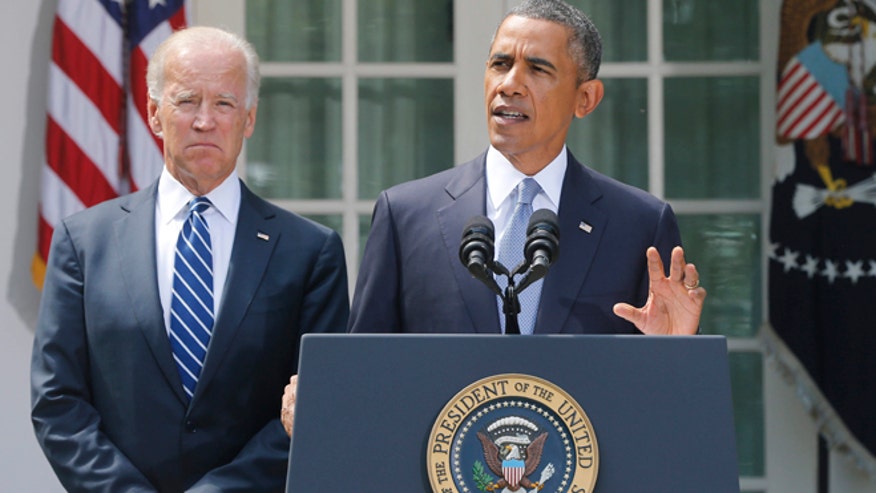
Obama_Syria8.jpgPresident Obama announced Saturday that he has concluded the United States should take military action against Syrian President Bashar al-Assad and his regime for using chemical weapons on civilians, but will first seek authorization from Congress.

“This menace must be confronted,” Obama said of the Assad regime’s alleged strike, speaking from the Rose Garden.

The announcement, though, sets up a timetable for debate that could drag on for weeks.

Obama said he would wait for Congress to return from recess; members are not scheduled to return until Sept. 9. Yet the president claimed any military response to Syria is “not time sensitive” and would be effective even one month from now.

The decision to seek congressional authorization is a departure from the administration’s decision to intervene in Libya in 2011. Though the president said he thinks he has the authority to order a military strike, he made clear he will ask Congress to vote on the issue.

“I have decided that the United States should take military action against Syrian regime targets,” the president said. He added: “I’m also mindful that I’m president of the world’s oldest constitutional democracy

Via: Fox News


Continue Reading....

Popular Posts