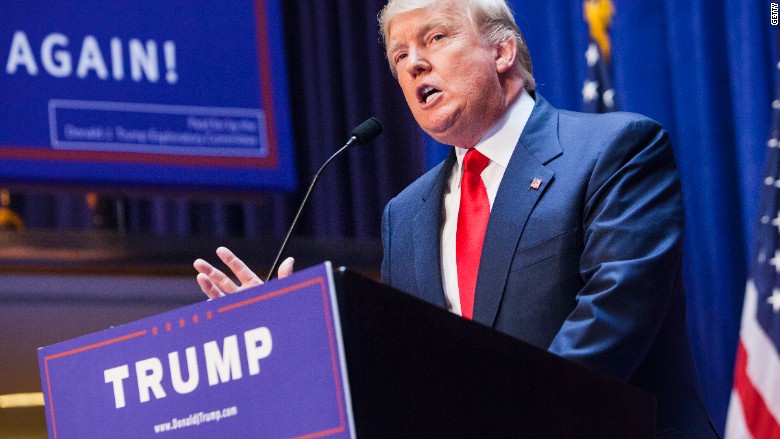
New York City's mayor has had enough Trump, thank you.
During a press conference on Monday, Mayor Bill de Blasio said that while he's uncertain whether the city can break several existing contracts with the Republican presidential hopeful, one thing is clear: There will be no future deals between the Big Apple and Trump.
Obama’s actions have been designed to turn America into a one-party state, much like the People’s Republic of China or Cuba or even Iran
For those who drank the hope and change Kool-Aid, here’s some bad news: the ‘fundamental transformation of America’ is in full swing and as they used to say in show biz, “you ain’t seen nothin’ yet!”
That’s because the last 18 months of this corrupt narcissist’s rule will make the first six-and-a-half years look like a high school civics lesson in good governance. I have always found it ironic that the son of a Kenyan Muslim Marxist and disaffected white liberal woman should grow up to become President of the United States. What’s more, the way in which he arrived at the presidency is shall we say, unusual.
Here’s a guy who was elected on the basis of being a good-looking black man who could speak well. We’ve never read anything that he wrote during his law school years, don’t know what his grades were, in fact, that entire chapter of his life is securely under seal. Why would that be?
And for those of us who believed that Constitutional Government entailed a series of checks and balances between the three branches of government, the Obama years have permanently disabused us of that notion.
Considering the shenanigans that brought about some of Obama’s ‘signature’ legislative achievements, there are Third World dictatorships with more transparent government than what’s the norm in America today. Think about the misnamed Affordable Care and Patient Protection Act, better known as ‘ObamaCare’ and how it was passed in the dead of night with no one having read its contents and with some of the crucial votes for passage having to be purchased through shady deals. Years later came the biting revelations by Jonathan Gruber, one of the Act’s authors that basically called voters ‘stupid’ for having accepted passage.
Then there is the use of the IRS to punish the enemies of the President. I recall a slight whiff of this from the Nixon White House when the impeachment knives began to be sharpened. Yet Obama uses this sinister and powerful agency to steal elections with impunity.
KT McFarland offered a blunt appraisal Monday of Secretary of State John Kerry’s claim that the United States had never sought “anytime, anywhere” inspections of Iran’s suspected nuclear sites.
“It’s a lie,” McFarland, a former State Department official for Ronald Reagan, said. “The reason anytime, anyplace inspections are crucial is because Iran in the past has cheated, so you really need ironclad inspections.”
“You think he was lying?” Fox News host Bill Hemmer asked.
“I think he wants this deal so badly he’s willing to stretch the truth around this,” McFarland responded.
Several of Kerry’s close confidants during the Iran negotiations, including Secretary of Energy Ernest Moniz and Deputy National Security Adviser Ben Rhodes, are on record earlier in the year assuring reporters that the United States would insist on “anytime, anywhere” inspections as part of any deal.
McFarland said the inspections process that the United States ultimately agreed to gives Iran the ability to stall inspectors for almost a month before they can visit a suspicious site.
“When the president said that we have 24-hour access to key nuclear installations, no you don’t—you have a 24-day period to request to look inside, and Iran has 24 days to say yes you can or no you can’t,” McFarland said.
Observers have expressed grave concern about the complicated bureaucratic mechanism that the United States will have to fight through at the United Nations to gain approval for an IAEA inspection.
By the time inspectors reach a suspected site, they may find only “elaborate cleanup efforts” like those that have been found at Iran’s Parchin military complex during past inspections.
Governor Scott Walker issued a blistering statement today in response to President Obama’s restoration of full diplomatic ties with the Castro regime and the opening of a Cuban embassy in the United States:
Today, the Castro regime is opening its embassy in the United States. Much like with Iran, desperation for a deal has led President Obama to give up much in exchange for almost nothing. The president has handed Cuba a financial lifeline through increased U.S. tourism and investment that will sustain the Castro regime and its oppression for decades to come. Meanwhile, the so-called normalization of relations between the U.S. and Cuba will do nothing to advance American interests or the interests of the Cuban people. A president who believes in American leadership and negotiates from a position of strength would use our leverage to advance U.S. interests and gain greater freedoms for the Cuban people. Unfortunately, President Obama refuses to do that.
Walker is now second in the polls, trailing Trump. He received a bump earlier in the year after pledging to curtail the issuance of new foreign worker visas when American workers had trouble finding jobs.
WASHINGTON – While safety concerns at military recruitment centers have been a long-standing issue, last week’s fatal shootings at two Tennessee installations underscore the deep risk recruiters face daily and the scramble at state and national levels to prevent a similar tragedy from taking place again.
The U.S. military on Monday confirmed to Fox News it directed recruiting centers across the country to step up security measures in the wake of the deadly rampage that claimed the lives of four U.S. Marines and a Navy sailor.
At the same time, a handful of governors have taken steps to beef up security measures at National Guard recruitment centers.
Governors in six states – Florida, Indiana, Arkansas, Oklahoma, Louisiana and Texas – ordered their Guardsmen to be armed.
Adm. Bill Gortney, head of the U.S. Northern Command, which oversees security for military facilities in the United States, issued a directive Sunday night calling on centers to implement modest measures while the Department of Defense hammers out more substantial steps to reduce the risk to recruiters.
Recruiters typically set up shop in highly-visible areas, like strip malls or storefronts to attract the most amount of people. Most are unarmed – and it’s this combination that some security analysts say creates the perfect conditions for an attack.
Not only are recruiters under pressure to deliver candidates who can clear basic mental and physical tests, they are doing so with ongoing budget cuts. The Air Force, Army, Navy and Marine Corps are being asked in fiscal year 2016 to recruit 2,000 to 9,500 more active-duty members.
After the governors' decision to arm Guardsmen, Florida Gov. Rick Scott took it a step further when he signed an executive order to relocate six recruiting centers to armories.
As governor, Scott oversees the Florida National Guard and can act without federal involvement. He also ordered officers to make sure all full-time members of the guard are armed “in the interest of immediately securing Florida National Guardsmen who are being targeted by ISIS.”
Authorities say Mohammod Abdulazeez, 24, opened fire at a military recruiting office in Chattanooga on Thursday. Thirty minutes and a police chase later, five military members and the gunman were dead.
While the shootings are being investigated as domestic terrorism, there has been no hard link between the attack and ISIS, authorities said.
Arkansas Gov. Asa Hutchinson authorized the Arkansas National Guard Adjutant Gen. Mark Berry to arm full-time military personnel.
“I want to join in those who are calling for greater security at our recruiting centers and military installations,” Hutchinson said. “We’ve had numerous instances of attacks. Clearly, they are a target, and for us to have unarmed military personnel makes no sense.”
Texas Gov. Greg Abbott announced Saturday he will authorize Adjutant Gen.John Nicholas of the Texas National Guard to arm National Guard personnel at military facilities across Texas.
“After the recent shooting in Chattanooga, it has become clear that our military personnel must have the ability to defend themselves against these types of attacks on our own soil,” he said. “Arming the National Guard at these bases will not only serve as a deterrent to anyone wishing to do harm to our service men and women, but will enable them to protect those living and working on the base.”
Louisiana Gov. Bobby Jindal, Oklahoma Gov. Mary Fallin and Indiana’s Gov. Mike Pence issued similar orders.
Governors in Georgia, Tennessee and North Carolina have not issued specific orders to arm but have started the process to step up security.
Tennessee Gov. Bill Haslam’s press secretary David Smith told the local paper the “governor has reached out to (Tennessee Adjutant) Genb. Haston, and we’re looking at appropriate next steps.”
Brian Robinson, spokesman for Georgia Gov. Nathan Deal, said the governor would not order National Guardsmen to arm themselves, “because current state law allows members of the Guard to arm themselves if they choose to.”
North Carolina’s Gov. Pat McCrory instructed the Department of Public Safety and the North Carolina National Guard to step up security measures at recruiting centers, armories and readiness centers statewide but did not issue an order forcing them to arm.
“We will be vigilant in protecting those who protect us,” McCrory said in a statement. “These men and women are putting their lives on the line to serve our country and it’s our responsibility to ensure everything that is within our power to do for their safety is done.”
Fox News' Lucas Tomlinson and The Associated Press contributed to this report.
On July 17, 1980, 35 years ago, when he accepted the Republican presidential nomination, Ronald Reagan—the great communicator—outlined what he intended to do as president with five little words—family, work, neighborhood, peace, and freedom.
Family.
Reagan was always outspoken about pro-life issues such as the need to protect the unborn child. In 1984, for example, he published “Abortion and the Conscience of the Nation,” becoming the first president to write a book while in office. In his acceptance address, he emphasized that “work and family are at the center of our lives, the foundation of our dignity as a free people.”
Work.
In his acceptance, Reagan argued that across-the-board tax cuts would jump-start the American economy—mired in stagflation as a result of Jimmy Carter’s failed policies. He stressed the dignity of work and said that the ability to support yourself was essential to a free people and a free nation.
“Reaganomics” proved to be the right medicine for our ailing economy—unemployment dropped dramatically, inflation subsided, and 17 million new jobs were added.
Neighborhood.
Reagan quoted Thomas Jefferson more than any other founder citing his firm commitment to liberty and limited government. In the face of an ever expanding federal government, candidate Reagan called for a renewal of “our compact of freedom.”
Echoing Alexis de Tocqueville and his praise of America’s voluntary associations, Reagan urged the people to restore “the American spirit of voluntary service, of cooperation, of private and community initiative.”
He promised that as president “everything that can be run more effectively by state and local government we shall turn over to state and local government, along with the funding sources to pay for it.” He would later call it “a New Federalism.”
Peace.
Reagan believed deeply in the concept of peace through strength—a phrase first used by President Dwight D. Eisenhower—and as president he championed a sophisticated, multi-faceted foreign policy that led, shortly after he left office, to the collapse of communism in Eastern and Central Europe and the dissolution of what he once called “an evil empire,” the Soviet Union.
In his 1980 address, he declared that “it is the responsibility of the President of the United States, in working for peace, to insure that the safety of our people cannot successfully be threatened by a hostile foreign power.”
As president, he strengthened the military, supported anti-communist forces around the world, and most critical of all introduced the Strategic Defense Initiative that convinced the Soviets they could not win the arms race.
Freedom.
In his acceptance remarks, Reagan promised to limit the overreach of the federal government into the lives of Americans. “We must have the clarity of vision,” he said, “to see the difference between what is essential and what is merely desirable; and then the courage to bring our government back under control.”
Through his historic tax cuts and pruning of non-essential services, President Reagan was able to free up the economy and enable Americans at all economic levels to spend their money as they and not the government wished.
At the same time, he initiated a Reagan Doctrine in foreign policy predicated on a simple solution to ending the Cold War: “We win and they lose.” By the end of the decade, and after Reagan had gone to Berlin and challenged the Soviet leadership, “Mr. Gorbachev, tear down this wall!” the wall was no more and all of Europe knew true peace for the first time in over 40 years.
As a candidate and as a president, Ronald Reagan cautioned against depending on one political leader or one political party. “My view of government,” he said, “places trust … in those values that transcend persons and parties. The trust is where it belongs—in the people. The responsibility to live up to that trust is where it belongs, in [our] elected leaders.”
Reagan saw himself as part of that relationship, committed to the first principles that had formed America and that keep her and all of us free. From beginning to end, he was a great communicator who understood the importance of great ideas and communicated them as no other president has in modern times.
The Obama administration wants to keep people collecting Social Security benefits from owning guns if it is determined they are unable to manage their own affairs, the Los Angeles Times reported.
The push, which could potentially affect millions whose monthly disability payments are handled by others, is intended to bring the Social Security Administration in line with laws that prevent gun sales to felons, drug addicts, immigrants in the United States illegally, and others, according to the paper.
The language of federal gun laws restricts ownership to people who are unable to manage their own affairs due to "marked subnormal intelligence, or mental illness, incompetency, condition, or disease” – which could potentially affect a large group within Social Security, the LA Times reported.
If Social Security, which has never taken part in the background check system, uses the same standard as the Department of Veterans Affairs – which is the idea floated – then millions of beneficiaries could be affected, with about 4.2 million adults receiving monthly benefits that are managed by “representative payees.”
The latest move is part of the efforts by President Obama to strengthen gun control following the Sandy Hook Elementary School massacre in 2012.
Critics are blasting the plan, saying that expanding the list of people who cannot own guns based on financial competence is wrongheaded.
The ban, they argue, would keep guns out of the hands of some dangerous people, but would also include people who simply have a bad memory or have a hard time balancing a checkbook.
The background check for gun ownership started in 1993 by the Brady Handgun Violence Prevention Act, named after White House Press Secretary James Brady, who was partially paralyzed after being shot in the 1981 assassination attempt on President Ronald Reagan.
Gun stores are required to run the names of potential buyers through a computerized system before every sale.
When the Dodd-Frank Act took effect on July 21, 2010, critics were fast to predict that the 2,300 page-long legislation, which passed the House without a single Republican vote and received only three GOP votes in the Senate would fail. Tomorrow will mark the five-year anniversary of Dodd-Frank and its unfortunate distorting effects. Just as when it was passed, the legislation remains unable to address the problems it was intended to.
The legislation has overwhelmed the regulatory system, stifled the financial industry, impaired economic growth, and done nothing to correct the pernicious effects of “too big to fail.” But that’s only the beginning: Many more of its regulations still need to be written, some several years down the road, all of which injects massive uncertainty into the financial industry. Here is a round-up of interesting articles to read before this sad anniversary. First, we have a great piece by Chairman Hensarling in the Wall Street Journal (“After Five Years, Dodd-Frank is a Failure.”). Thankfully for us, the chairman is as committed to getting rid of Dodd-Frank as he was to getting rid of the Ex-Im Bank. I wish him the same success and more. The whole thing is worth a read, but here are a few paragraphs: Dodd-Frank was supposedly aimed at Wall Street, but it hit Main Street hard.
Community financial institutions, which make the bulk of small business loans, are overwhelmed by the law’s complexity. Government figures indicate that the country is losing on average one community bank or credit union a day. Before Dodd-Frank, 75% of banks offered free checking. Two years after it passed, only 39% did so—a trend various scholars have attributed to Dodd-Frank’s “Durbin amendment,” which imposed price controls on the fee paid by retailers when consumers use a debit card. Bank fees have also increased due to Dodd-Frank, leading to a rise of the unbanked and underbanked among low- and moderate-income Americans. Has Dodd-Frank nevertheless made the financial system more secure? Many of the threats to financial stability identified in thelatest report of Dodd-Frank’s Financial Stability Oversight Council are primarily the result of the law itself, along with other government policies. There’s also a new report by John Berlau at CEI that shows how Dodd-Frank has stifled competition among the banks even more so than before the financial crisis.
A failure to approve new banks, for instance, means that those “too big to fail” banks are now more entrenched than ever. In the last five years, regulators have approved only one new bank, as opposed to an average of 170 new banks per year before 2010. As Berlau notes: “This lack of new bank competitors is one important reason why a large bank failure could severely curtail the supply of credit and availability of financial services. That in turn sets the stage for a continuing cycle of bailouts.” The New York Times has an interesting piece (“Fannie and Freddie are Back, Bigger and Badder Than Ever“) by Bethany McLean. It’s must read recap of the promises of what Freddie and Fannie would achieve vs. actually happened, along with the failure to reform two agencies in the aftermath of the financial crisis. The proposed solutions for this mess? Among other things,
Senator Warren believes it’s time to bring back the Glass-Steagall Act, a law that would require big banks to divide commercial and investment banking. Most economists and Federal Reserve policymakers disagree that the repeal of Glass-Steagall had anything to do with the financial crisis but, Democratic presidential candidates Bernie Sanders Martin O’Malley support the idea nonetheless. Hillary Clinton hasn’t said yet what she thinks of the proposal. However, according to Kevin Cirilli at The Hill, the White House is distancing itself from this push: The White House wants to keep its distance from a liberal push to re-implement legislation that would break up big banks… “At this point, we believe that the kind of implementation of Wall Street reform is the most effective way to protect our economy and middle-class taxpayers,” White House press secretary Josh Earnest told reporters at a press briefing Friday when asked whether President Obama supports it. … Earnest said the administration is still focused on implementing the 2010 Dodd-Frank Wall Street Reform law. “Wall Street reform has been incredibly effective at reforming our financial system in a way that looks our for the interests of middle-class families and taxpayers,” Earnest said.
The U.S. Navy has a problem. Or rather, it has two intertwined problems, one material and one intellectual and cultural. To all appearances, thankfully, the sea service has resolved to attack both of them. As psychologists say, admitting you have a problem is the first step toward solving it. And, I would add, it’s the biggest and most consequential step. Once you reorient yourself, deciding and acting constitute the easy part—relatively speaking, anyway. Ergo…
Huzzah!
The first of the navy’s woes is material. By and large American fighting ships and shipborne aircraft remain second to none as platforms. They’re festooned with state-of-the-art sensors, fire-control systems, propulsion plants, you name it. But the weapons they pack have fallen behind increasingly competitive times. Not since the early 1990s, for instance, has the surface navy procured a new anti-ship cruise missile (ASCM), its chief weapon for fleet-on-fleet engagements.
Time and technology moved on in the interim. Prospective competitors, notably China, have imported or manufactured missiles boasting greater reach, speed, and often times striking power than their U.S. counterparts. The U.S. Navy’s Harpoon missile, or standard ASCM,can strike at targets circa 76 miles distant. Impressive—except some Chinese ASCMs boastover triple that range, while the vast majority outrange the Harpoon by a sizable margin.
Which leaves American surface warriors—among whom I count myself despite the lapse of, ahem, a few short years—inhabiting an awkward spot.
Think about it in boxing terms. What happens when a short, stubby-armed boxer packing a crushing right squares off against a tall, rangy, equally musclebound opponent? It’s an unequal fight—never mind the apparent parity of strength. The long-armed pugilist jabs away from out of reach. He scores lots of points, and lands lots of blows. Sure, the brawny little guy may be a heavy hitter—but he takes a heckuva beating while closing the distance enough to counterpunch.
That takes its toll. Worse, the short-armed boxer may never get within reach. He could suffer a knockout before ever getting close enough to unleash that right. Likewise, never getting within missile range while an enemy pounds away is a Bad Thing in sea combat. Which antagonist fields the better platforms matters little if one fleet gets in range to deploy its principal armament and the other doesn’t.
Far better to lengthen your reach while amassing battle power—making yourself the tall, rangy, musclebound pugilist.
Which is why recent news out of the defense-technology world warms the heart of any American sailor. Last month off the California coast, a Tomahawk Block IV cruise missile repurposed for anti-ship missions slammed into a moving target at sea. It was fired from destroyer USS Kidd and guided by position data relayed from a F/A-18 Super Hornet aircraft overhead.
The reconfigured Block IV constitutes a new, old capability—the sort of undead U.S. mariners like. The navy leadership ordered Tomahawk anti-ship cruise missiles (TASMs) withdrawn from the fleet during the 1990s, when U.S. maritime supremacy appeared beyond challenge and the sea service turned its attention to projecting power ashore. That took a very, very long-range weapon out of the surface (and subsurface) navy’s arsenal—a weapon that would outdistance most if not all of its competitors on the high seas today.
Restoring that range advantage would restore the surface fleet’s fighting edge over competitors—matching superior platforms with superior combat power. Small wonder Deputy Secretary of Defense Bob Work touts the nouveau TASM as an inexpensive “game-changing capability.” The missile—the expensive component—exists. Fielding a new seeker to find and target shipping is relatively straightforward.
Still to come: a test of the Long-Range Anti-Ship Missile (LRASM), a “bird” under development since 2009 under the auspices of the Defense Advanced Research Projects Agency—the Pentagon’s analogue to Q, the high-tech wizard from the James Bond films. If test-fired successfully from the vertical-launch system carried aboard surface combatants, the LRASM will add another arrow to the navy’s quiver in the not-too-distant future. Faster, please.
Neither bird is perfect. Both the Tomahawk and LRASM remain subsonic missiles, which means it takes them a long time to reach distant targets, which means the target may have moved by the time the missile reaches assigned coordinates, which means these weapons will presumably rely on airborne updates of the type used during last month’s test—even once perfected. Networking shooter with aircraft with missile opens up opportunities for mischief-making by adversaries who have every incentive to balk U.S. naval operations. Such is the reality of naval warfare.
Still, these are encouraging developments all around. For an appraisal of the second problem besetting our navy…tune in next week!!!
Appearing on CNN Newsroom with Poppy Harlow on Sunday evening, liberal CNN contributor and Morehouse College Professor Marc Lamont Hill asserted that it was "stupid" for former Maryland Governor Martin O'Malley to declare that "All lives matter" during a far left Netroots Nation event over the weekend.
Hill went on to compare the Maryland Democrat's comments to declaring that "all houses matter" when there is only one house on fire that needs immediate attention.
After fellow guest and conservative talk radio host Ben Ferguson jabbed Hillary Clinton for refusing to show up at the Netroots event, Hill complained about her absence:
I understand Ben's point, which is that, as a political calculus, it's better to run from this stuff than to take it head on because you end up saying something stupid like, "All lives matter," like Martin O'Malley did.
Poppy Harlow requested clarification from him as she posed:
Real quick, explain to those who might not understand why it was offensive to say, "All lives matter."
Hill began:
Well, outside of context, saying, "All lives matter," is reasonable, right? All lives do matter. The Black Lives Matter movement has never been about denying the legitimacy of other people's suffering. It's never been about saying all lives don't matter or that black lives are superior to other lives. The point is that there's a crisis going on. There is a crisis in the black community of state violence. There's a crisis of extra-judicial violence against black bodies. There's a crisis of mass incarceration, of poverty.
The liberal professor continued:
All these things are happening and they're targeted, disproportionately targeted toward black people. And to develop a movement and say black people need support in this way, black people's lives need to be affirmed and confirmed and protected in this way, to make that movement, and then to have people say, "Hey, but what about white people?" to me is to avoid the point. It's almost as if saying we can't affirm the humanity of black people without also bringing in some white people, we can't talk about the value of black life unless we talk about something else.
If there are two houses on a hill, one is on fire, I'm not going to scream out, "All houses matter!" I'm going to put out the fire in the one that's on fire. Right now, there's a fire in the black community.
PORTLAND, Ore. (AP) — An Oregon resident who transitioned to a woman more than three decades ago continued collecting Social Security disability checks under her male identity, fraudulently raking in $250,000.
Court records show Richelle McDonald was born Richard McDonald in 1945. In 1974, Richard claimed disability because he was unable to work after suffering a serious arm injury when hit by a San Francisco bus.
McDonald in the 1970s also applied for a separate Social Security number under the name Richelle. She worked under that name from the early 1980s until 2012 while continuing to collect disability payments as Richard.
McDonald pleaded guilty to Social Security fraud in December and was sentenced Monday to eight months of home confinement. She must also pay restitution.
Uber is twice as fast as taxi service and about half the cost of a regular taxi, according to a new study of the company's ride-sharing app conducted in Los Angeles.
The average UberX ride took just under 7 minutes to arrive, versus over 17 minutes for a taxi requested by phone. For the same rides, the average UberX trip cost $6.40, while the cost of using the taxi was $14.63, including tip.
UberX gets people rides through private people driving their own cars, instead of professional drivers.
The study was conducted by the research firm BOTEC Analysis and funded by Uber, the leading ride-sharing company that has seen massive success but also tough opposition from regulators and taxi companies, which have charged that Uber can hurt poor people.
"The evidence in hand strongly suggests that UberX outperforms conventional taxis in serving low-income neighborhoods, at least in Los Angeles," wrote Mark Kleiman, a professor of public policy at New York University and the chairman of BOTEC, in a blog post Monday.
The study sent pairs of riders out in low-income neighborhoods in Los Angeles and asked them to alternate between hailing private drivers through Uber or taxis for pre-selected routes. The riders, who were hired through a staffing agency and didn't know the study was funded by Uber, collected data relating to arrival times and costs. The study noted that it is not typical to hail taxis on the street in Los Angeles' sprawling neighborhoods.
The study did not test the app versus taxis anywhere other than Los Angeles, nor did it measure other variables of interest in the debate over ride-sharing and other so-called "sharing economy" apps, such as service to disabled people, availability in all neighborhoods, or treatment of different ethnic or racial groups.
Nor did it address the welfare of the people providing the service, which was the question raised by Democratic presidential candidate Hillary Clinton in a speech on the economy last week. Clinton said the rise of sharing economy companies was "raising hard questions about workplace protections and what a good job will look like in the future."
• This article has been corrected to reflect that Mark Kleiman is a professor at New York University.
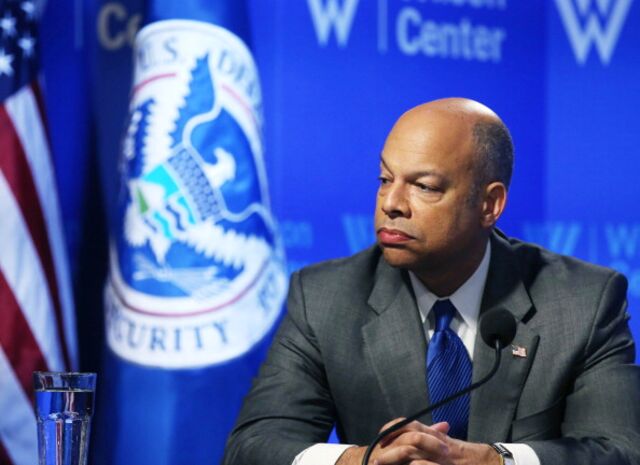
Jeh Johnson, the secretary of homeland security, and 28 of his senior staffers have been using private Web-based e-mail from their work computers for over a year, a practice criticized by cybersecurity experts and advocates of government transparency.
The department banned such private e-mail on DHS computers in April 2014. Top DHS officials were granted informal waivers, according to a top DHS official who said that he saw the practice as a national security risk. The official said the exempt staffers included Deputy Secretary Alejandro Mayorkas, Chief of Staff Christian Marrone and General Counsel Stevan Bunnell.
Asked about the exceptions on Monday, the DHS press secretary, Marsha Catron, confirmed that some officials had been exempted. "Going forward," she said, "all access to personal webmail accounts has been suspended."
Future exceptions are to be granted only by the chief of staff. Catron said that a "recent internal review" had found the chief of staff and some others were unaware that they had had access to webmail.
The DHS rule, articulated last year after hackers first breached the Office of Personnel Management, states: "The use of Internet Webmail (Gmail, Yahoo, AOL) or other personal email accounts is not authorized over DHS furnished equipment or network connections." Johnson and the 28 other senior officials sought and received informal waivers at different times over the past year, the official said. Catron said exceptions were decided on a case-by-case basis by the chief information officer, Luke McCormack. DHS employees are permitted to use their government e-mail accounts for limited personal use.
Erica Paulson, a spokeswoman for the DHS Office of the Inspector General, said that the office does not confirm or deny the existence of any open investigations.
It remains unclear whether Johnson and the other officials conducted DHS business on their private webmail accounts. (The DHS spokeswoman said "the use of personal e-mail for official purposes is strictly prohibited.") If even one work-related e-mail was sent or received, they could be in violation of regulations and laws governing the preservation of federal records, said Jason R. Baron, a former director of litigation at the National Archives and Records Administration.
"I suppose it is remotely conceivable that in seeking a waiver, 20 or more government officials could all be wishing to talk to each other through a Web-based e-mail service about such matters as baseball games or retirement luncheons they might be attending," he said. "But it is simply not reasonable to assume that in seeking a waiver that the officials involved were only contemplating using a commercial network for personal (that is, non-official) communications."
In March, the New York Times reported that as secretary of state, Hillary Clinton had used a private e-mail server exclusively to conduct her State Department business. Clinton said she had not violated any transparency laws because the Federal Records Act states that officials are permitted to use private e-mail, so long as they forward on any government-related communications to their government accounts so they can be archived and used to respond to requests under the Freedom of Information Act.
In November 2014, the Federal Records Act was amended to impose a 20-day limit on the time an official has to transfer records from private e-mail to government systems. Clinton transferred over 30,000 e-mails from her private server to the State Department in early 2015. She deleted another 30,000 e-mails on her private server, claiming they were all strictly personal.
It is unclear how Johnson and the other officials used their webmail accounts, and whether they forwarded any messages about government business to their official accounts.
Johnson has used his personal Gmail for government business at least once, before he was head of DHS; that was disclosed during the scandal that led to David Petraeus's resignation as CIA director. The Justice Department is fighting to keep Johnson from having to give a video deposition in that case.