Thursday, June 25, 2015

Charleston's Quieter Lessons

Last Thursday, America woke up to the horrifying news of a massacre in a historic black church. Dylann Roof, a devout racist, walked into a Bible study, listened to innocent people discuss their faith for an hour, and then shot and killed nine of them in cold blood.
Two days after the killings, Americans were shocked once again—but this time, the surprise came from the families and friends of the murdered churchgoers. One by one, gathered at Roof’s bond hearing, a group of Christians publicly forgave and prayed for a decidedly evil person who, except for a few fleeting, eye-flickering onscreen moments, seemed without a soul. 
It was the Gospel in practice. It’s not something you see every day, at least not in the fever swamps of our relentless, gurgling, insatiable media, which increasingly resemble a starving narrative monster on speed. As an ever-imperfect Christian, the forgiveness was humbling—almost shamefully so—to watch. Sadly, for some, Charleston’s transcendent moment appears to be slipping away, likely because it was so contrary, and so foreign, to our media culture at large.
From one corner, for instance, we are now told that forgiveness is a tool of oppression. “The almost reflexive demand for forgiveness, especially for those dealing with death by racism, is about protecting whiteness, and America as a whole,” wrote Stacey Patton in Monday’s Washington Post. “What white people are really asking for when they demand forgiveness from a traumatized community is absolution,” Roxanne Gay argued in Wednesday’s New York Times. “Can’t remember any campaign to ‘love’ and ‘forgive’ in the wake of ISIS beheadings,” Atlantic monthly writer Ta-Nehisi Coates wrote on Twitter. 
That last point is undoubtedly true. But here’s the problem: Prior to the church’s radical act of forgiveness, there was no large-scale “campaign” or “demand” or “narrative” that asked them to do anything of the sort. Search the news and social media leading up to that mind-blowing hearing, and you’ll come up empty. Very few, in fact, saw anything like the church’s response coming. That’s what made it so unexpected, so beautiful, and so astonishing—and, in a culture that often thrives on outrage, so disorienting.

Sotomayor's 4th Amendment Time Bomb

A painfully slim 5 – 4 ruling this week by the Supreme Court in City of Los Angeles v. Patel is being greeted by many privacy advocates almost with the ebullience of Gene Kelly’s heel-clicking dance in Singin’ in the Rain.

The court struck down a Los Angeles ordinance that allowed police officers to inspect hotel guest registries for any or even no reason, and without a warrant. The ruling that the Fourth Amendment applies to businesses and that statutes may be declared unconstitutional on their face is consistent with principles as old as, and even older than, the Constitution.

Privacy advocates seem to be suffering from a bit of Stockholm Syndrome. Joyful about the court’s barely holding the line on two issues, most have yet to acknowledge how Justice Sonya Sotomayor’s majority opinion is also a blueprint for a major power grab for the administrative police state.

What’s lost in the celebration is that Justice Sotomayor’s majority opinion recommends the use of judge-less “administrative subpoenas” for these searches. That will shift costs and burdens of proof from government onto unwitting or intimidated small business owners under judicial standards that give nearly complete deference to the government, and with no need to show probable cause for searches. Her majority opinion even seems to suggest that police departments may be given power to approve their own searches using administrative subpoenas instead of going to judges to obtain warrants.

Sotomayor’s opinion starts out promisingly well. She refers to the Ninth Circuit Court of Appeals ruling below that “’[t]he business records covered by [the city ordinance] are the hotel’s private property’ and the hotel therefore ‘has the right to exclude others from prying into the[ir] contents.’” She then notes that “searches conducted outside the judicial process, without prior approval by [a] judge or magistrate . . . are per se unreasonable . . . subject only to a few specifically established and well-delineated exceptions.” Those time-honored exceptions include consent of the property owner, or “exigent,” meaning “emergency,” circumstances.
Justice Sotomayor’s promising start then goes south with dicta promoting the use of “administrative subpoenas,” which are issued by bureaucrats, not judges, and absent probable cause required by the Fourth Amendment. Even if small business owners are not intimidated or know they can obtain hearings to suppress these search demands, that is, if they can afford going to court, the judicial standard of deference to these judge-less warrants makes it nearly impossible for citizens or businesses to block such searches.


FAREWELL TO THE RULE OF LAW: SUPREME COURT UPHOLDS OBAMACARE SUBSIDIES

The rule of law was formally put out to pasture by the Supreme Court on Thursday, as we discovered that the plain text of a law matters less than what the party in power thinks it should mean.

On a 6-3 vote in the King v. Burwell case, with Chief Justice John Roberts and Anthony Kennedy joining the liberal bloc vote of Ginsburg, Breyer, Sotomayor, and Kagan, the Court decided to allow the federal ObamaCare exchanges to continue distributing taxpayer subsidies for health insurance, even though the Affordable Care Act explicitly reserves those subsidies for state exchanges, and there is ample evidence the authors of ObamaCare knew what they were doing when they inserted that language into the law.
They simply changed their minds later, when the political ground shifted. Most states didn’t set up exchanges, several those which did abandoned them, and cutting off the ObamaCare subsidies could have scuttled the entire scheme.
Much of the punditry on both Left and Right leading up to the decision assumed the Court would nix the federal subsidies, sticking congressional Republicans with the outrageous burden of saving a law none of them voted for. (Let’s be honest: after watching the new Republican majority in action, it’s highly likely that they would have done so, with minimal political pain for the Democrats.) If the Internet is running a bit slow today, it’s probably because ten thousand “What the GOP Must Do to Save ObamaCare Now” articles are being deleted.
Justice Antonin Scalia, in dissent, growled that ObamaCare should be called “SCOTUSCare” now, because the Supreme Court has rewritten it twice to keep it alive. It should go without saying that this is not how the American system of government was supposed to work.
The majority decision actually does make it clear this is a pure exercise of political power. Chief Justice John Roberts writes, after reviewing the debate over what the “exchange established by the state” language means:
The upshot of all this is that the phrase “an Exchange established by the State under [42 U. S. C. §18031]” is properly viewed as ambiguous. The phrase may be limited in its reach to State Exchanges. But it is also possible that the phrase refers to all Exchanges—both State and Federal—at least for purposes of the tax credits. If a State chooses not to follow the directive in Section 18031 that it establish an Exchange, the Act tells the Secretary to establish “such Exchange.” §18041. And by using the words “such Exchange,” the Act indicates that State and Federal Exchanges should be the same. But State and Federal Exchanges would differ in a fundamental way if tax credits were available only on State Exchanges—one type of Exchange would help make insurance more affordable by providing billions of dollars to the States’ citizens; the other type of Exchange would not.

What an amazing pile of drivel, so utterly unworthy of the Supreme Court. And what a dangerous precedent to set for the final destruction of the American system of limited powers and equal branches of government. The proper remedy for a poorly-written “ambiguous” law is to send it back to the legislature to fix it, not let a block of liberal justices declare that ambiguous language is the gateway to even greater power.
Via: Breitbart
Continue Reading...

Customs Agents To James O’Keefe: You’re Being Detained For Investigating The Federal Government

Project Veritas founder James O
U.S. Customs and Border Patrol agents who detained conservative filmmaker James O’Keefe at the airport specifically asked him about the work he’s done investigating the “federal government.”
3

O’Keefe was detained by U.S. customs agents Monday after arriving at the airport in Nassau, Bahamas en route to Miami. Agents told O’Keefe that he was being detained for crossing back and forth across the U.S.-Mexico border while dressed as Osama bin Laden in a video that was published by The Daily Caller. Agents marked his passport with an “X” and explained that he would be detained every time he enters U.S. territory henceforth. (RELATED: Feds Detain At Least One Border Crosser).
8

O’Keefe was not allowed to videotape the encounter as he wished. The below transcript, provided to TheDC, was written by O’Keefe as closely as possible to the actual conversation that he had with the customs agents during the standoff at the airport. Here is the dialogue that went down:
3

James: Well, each and every time I go back into the country you guys do this, and its because I’m a journalist and you don’t like my journalism, so let’s just get this over with, here’s my ticket with the X, just tell what room you want me in.
Customs: (Looking at computer for 15 seconds). It’s not because you’re a journalist. (Turns towards me). What type of journalism do you do?
What do you think?

James: I do like 60 minutes, hidden camera work, investigative, sort of like the guy who catches the predators on NBC Dateline you know?
1

Customs: But what specific type of journalism have you done investigating the federal government?
What do you think?

James: Well, first ACORN was shut down because I posed as a pimp.
What do you think?

Customs: Not the prostitution, the other one involving the federal government.
What do you think?

James: You mean the Obamacare navigators, where many were fired counseling to commit fraud?
2

Customs: No not that one, what did you do involving the federal govenrnment at the borders?
1

James: Well clearly you know which video that was. Why don’t you tell me?
1

Customs: No, I need you to tell me.
1

James: That was the one where I legally waded into the Rio Grande dressed like Osama bin Laden and embarrassed the federal government. DHS secretary was grilled under oath. Are you telling me this is retaliation for that?
1

Customs: I’m telling you that each time you go through here you will need to give an extra hour because we will do this each time. You have a prior criminal record and broke the law crossing into the United States unlawfully.
3

James: It wasn’t unlawful, I did nothing but wade back and forth. Millions of Mexicans cross and you don’t detain them for unlawful entry
3

Customs: You broke the law!
What do you think?

James: I broke the law? I’m a journalist who is trying to expose something important. Deep down in your heart when you set the burocreacy aside you have admit it needed to be exposed.
2

Customs: Come with me.

Is the Obamacare Fight Over? - 15 health care wonks weigh in.


The Supreme Court today upheld a key provision in the Affordable Care Act, ruling 6 to 3 in King v. Burwell to maintain federal subsidies for state exchanges. Politico Magazine asked leading thinkers in health care policy for their take on the future of the ACA and American health care. Is Obamacare here to stay? What will happen to the exchanges? And most important: Is the legal and political fight over?
***
Larry Kramer, president of the Hewlett Foundation and former dean of Stanford Law School

That this case was even in the Supreme Court is an embarrassment for the Court—and a sign of how ideological and politicized the federal bench has become. That we had to wait with bated breath to see whether a majority of the Justices would uphold this ridiculous challenge is an even bigger embarrassment and worse sign. At no other time in U.S. history would a challenge this frivolous to a law of this significance have been close, even for Justices whose politics were opposed to those of the President and Congress that enacted the law.

6-3 is better than 5-4, and it’s certainly better than a result the other way. But something is deeply wrong when the nation has to sit on pins and needles to see whether a couple of lawyers will give their blessing to our most important laws. Cases like this underscore the deeply problematic nature of the role the Supreme Court has come to play in American society.

In celebrating that the Justices reached what was (to any fair minded person) an obvious result, we legitimize the idea that it is okay for them to play this role and so empower them to take over more and more of the space properly reserved for self government and democratic politics. The people who founded this nation did not fight and die to replace a monarchy with an oligarchy.


Was Supreme Court Justice John Roberts Blackmailed?

It’s time to start asking the question. It’s time to be cynical. It’s time to assume the worst of this government.
Has Supreme Court Justice John Roberts been blackmailed or intimidated?
I would put nothing by the Obama administration that lives and rules by the Chicago thug playbook.
Doubt me? On the same day that Justice Roberts and the Supremes upheld Obamacare – again – the key IRS watchdog reported to Congress that the IRS purposely destroyed evidence of a crime.
Republicans are being blackmailed, intimidated, extorted and bribed.
Share:
Is the idea implausible that this same Obama administration that orders IRS attacks, then orders destruction of key evidence, would stop at nothing to save Obama’s signature achievement? Is it impossible to believe that Obama and his socialist cabal that learned from Saul Alinsky that “the ends justify the means” would hold something over a Supreme Court justice’s head?
It’s time to ask the question loudly and boldly because something is clearly wrong in Washington, D.C.
Is that the purpose of government agencies like the IRS and the NSA that are abusing our rights – to listen to us, to watch us, to find something we’ve done wrong, and then use it to intimidate, harass, threaten or extort key political figures so that Obama can “fundamentally change America”?
Because something clearly smells rotten in Washington, D.C. Like “the mafia delivering a dead fish to your door” rotten. Conservatives just won national elections in a massive wave, a historic landslide. We control both houses of Congress; we control the Supreme Court, yet we continue to lose every key vote in Congress and every key Supreme Court ruling.

Fox News Fires Bob Beckel, Politico's Dylan Byers Reports

"Fox News has officially dropped 'The Five' co-host Bob Beckel from the network, saying the show could no longer be held 'hostage' to his personal issues," Dylan Byers of Politico reported earlier this afternoon, adding: 
"We tried to work with Bob for months, but we couldn’t hold The Five hostage to one man’s personal issues," Bill Shine, executive vice president of programming, said in a statement. "He took tremendous advantage of our generosity, empathy and goodwill and we simply came to the end of the road with him."
Shine said Fox News personalities Juan Williams and Geraldo Rivera will be "among those rotating on the show for the near future.”
Beckel, who joined the network in 2000, had entered rehab therapy for his addiction to prescription pain medication in April. His last appearance on the network was Feb. 16, more than four months ago. News of his departure from Fox was first reported by Mediaite.
To read the full piece, click here.

Supreme Court upholds key tool for fighting housing bias

The Supreme Court handed a surprising victory to the Obama administration and civil rights groups on Thursday when it upheld a key tool used for more than four decades to fight housing discrimination.
The justices ruled 5-4 that federal housing laws prohibit seemingly neutral practices that harm minorities, even without proof of intentional discrimination.
Justice Anthony Kennedy, often a swing vote, joined the court's four liberal members in upholding the use of so-called "disparate impact" cases.
The ruling is a win for housing advocates who argued that the housing law allows challenges to race-neutral policies that have a negative impact on minority groups. The Justice Department has used disparate impact lawsuits to win more than $500 million in legal settlements from companies accused of bias against black and Hispanic customers.
In upholding the tactic, the Supreme Court preserved a legal strategy that has been used for more than 40 years to attack discrimination in zoning laws, occupancy rules, mortgage lending practices and insurance underwriting. Every federal appeals court to consider it has upheld the practice, though the Supreme Court had never previously taken it up.
Writing for the majority, Kennedy said that language in the housing law banning discrimination "because of race" includes disparate impact cases. He said such lawsuits allow plaintiffs "to counteract unconscious prejudices and disguised animus that escape easy classification" under traditional legal theories.

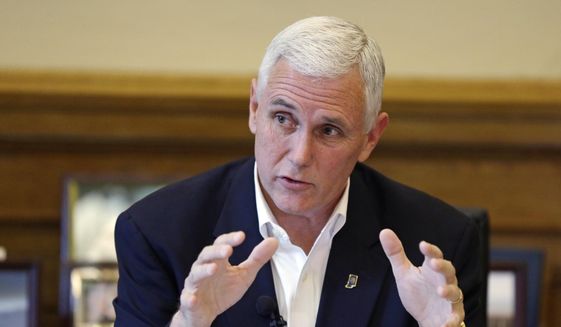
Mike Pence, Indiana governor, says he’ll defy Obama’s carbon regulations

Indiana Gov. Mike Pence discusses the legislative session that ended the day before during a news conference at the Statehouse in Indianapolis, in this April 30, 2015, file photo. (AP Photo/Michael Conroy)
Indiana Gov. Mike Pence said Wednesday he will not comply with the Obama administration’s proposal to limit carbon emissions from existing power plants, the centerpiece of the president’s climate-change agenda.
In a letter to President Obama, Mr. Pence demanded that major changes be made to the plan. If those changes are not made, the governor said his state will defy the Environmental Protection Agency regulations, formally known as the Clean Power Plan.
“If your administration proceeds to finalize the Clean Power Plan, and the final rule has not demonstrably and significantly improved from the proposed rule, Indiana will not comply. Our state will also reserve the right to use any legal means available to block the rule from being implemented,” Mr. Pence said in the letter. “Energy policy should promote the safe, environmentally responsible stewardship of our natural resources with the goal of reliable, affordable energy. Your approach to energy policy places environmental concerns above all others.”
The final version of the Clean Power Plan is expected to be released in August. It would dramatically limit carbon emissions from power plants, and the EPA estimates overall U.S. carbon emissions would fall dramatically as a result of the plan.
The agency also admits that the amount of American energy generated by coal would fall by 25 percent after the plan is implemented.
Energy companies and a coalition of states already have challenged the plan in court, but the lawsuit was deemed premature and ultimately was dismissed. Opponents have vowed to file new lawsuits after the final plan is unveiled.


Kids Create Salt Black Markets in Cafeterias Due to Michelle Obama’s Lunch Rules

School administrators testify to Congress on ‘unintended consequences’ of the law


Children are creating their own black markets to trade and sell salt due to First Lady Michelle Obama’s school lunch rules.
During a hearing before the House Subcommittee on Early Childhood, Elementary, and Secondary Education, chaired by Rep. Todd Rokita (R., Ind.), a school administrator told Congress of the “unintended consequences” of the Healthy, Hunger-Free Kids Act.
“Perhaps the most colorful example in my district is that students have been caught bringing–and even selling–salt, pepper, and sugar in school to add taste to perceived bland and tasteless cafeteria food,” said John S. Payne, the president of Blackford County School Board of Trustees in Hartford City, Indiana.
“This ‘contraband’ economy is just one example of many that reinforce the call for flexibility [with the rules],” he said.
Payne noted other problems with the “one-size-fits-all” approach to providing healthier meals to students, including fewer kids participating in the program and higher food waste. The trend started in 2012, when the school lunch law, which was championed by Mrs. Obama, went into effect.
“Students are avoiding cafeteria food,” Payne said. “More students bring their lunch, and a few parents even ‘check out’ their child from campus, taking them to a local fast-food restaurant or home for lunch.”
Payne also said school fundraisers like bake sales, have been canceled due to the rules, and “whole-grain items and most of the broccoli end up in the trash” in his district.
Dr. Lynn Harvey agreed that the whole-grain requirement is not working, as kids refuse to eat dense and dry biscuits, and “unpalatable” grits.
“When it comes to whole grain-rich variations of biscuits, grits, crackers and cornbread, all too often, students simply toss them into the trash cans,” said Harvey, who serves as chief of school nutrition services at the North Carolina Department of Public Instruction, which oversees lunch programs for schools that enroll 1.5 million students.
“This product dissatisfaction has contributed to a decline in breakfast participation in 60 percent of North Carolina’s school districts,” she said.

[VIDEO] Supreme Court Rules 6-3 to Save Obamacare Tax Subsidies

Popular Posts