Wednesday, September 2, 2015

Plan targets health care bias against transgender people

FILE - In this July 21, 2014 file photo, President Barack Obama pauses as he speaks before signing executive orders to protect LGBT employees from federal workplace discrimination in the East Room of the White House in Washington.  The Obama administration has proposed to ban discrimination against transgender people throughout the health care system, carrying out anti-bias provisions in the president's health overhaul.   (AP Photo/Jacquelyn Martin)
WASHINGTON (AP) — Mirroring a shift in society, the Obama administration proposed Thursday to ban discrimination against transgender people throughout the health care system.
Once the proposed regulations are final, they should expand insurance coverage for gender transition and prohibit health care facilities from denying transgender people access to restrooms that match their individual gender identity.
The new protections are part of a broader rule from the Department of Health and Human Services to carry out anti-bias provisions of President Barack Obama's health care law. In a first, the law specified that sex discrimination is prohibited in health care, and the regulation carries it a step further, clarifying that "gender identity" is included under that protective umbrella.
"This is a huge step," said Michael Silverman, director of the Transgender Legal Defense and Education Fund in New York. "It covers a lot of ground."
The new transgender policy comes as social attitudes about sexuality and gender are undergoing major changes. The Supreme Court recognized a constitutional right for same-sex couples to marry, and the gender transition of Olympian Bruce Jenner from male to female — Caitlyn — has brought new awareness about a group often ostracized by society.
The long-delayed rule amounts to a manual for carrying out the health law's prohibition against medical discrimination on the basis of race, color, national origin, sex, age, or disability. Those underlying provisions already are in effect.
Jocelyn Samuels, head of the HHS Office for Civil Rights, said the rule does not explicitly require insurers to cover gender transition treatment, including surgery. But insurers could face questions if they deny medically necessary services related to gender transition by a man who identifies as a woman, or a woman who identifies as a man.
"It is basically a requirement that insurers use nondiscriminatory criteria," Samuels told reporters.
Advocates for transgender people note that insurers already pay for services such as hormone treatments and reconstructive surgery, but decline to cover them when they're part of a gender transition.
"What the rule says is they cannot exclude transgender people from the services that other people have," said Harper Jean Tobin, policy director for the National Center for Transgender Equality.
Currently, 10 states plus Washington, D.C., require private insurers to cover transgender health care, while six states plus the nation's capital cover such services through their Medicaid programs, according to advocates.
The new requirements would have impact throughout the health care system because service providers who accept federal dollars would have to comply.
Medicare and Medicaid are the cornerstone of hospital finances. That means transgender people could not be restricted from access to bathrooms or hospital wards consistent with the gender that they identify with, Samuels said.
Most doctors would be covered. Insurers that offer plans through HealthCare.gov would have to comply with the requirements in their plans off the health insurance exchange as well.
The regulation may not be final for many months. The public comment period extends through Nov. 6, and officials are seeking comment on a range of difficult issues, including religious conscience protections for service providers and whether sexual orientation — whether a person is a gay man or a lesbian — should also be protected.
Other advocates were disappointed with a separate section of the rule addressing discriminatory insurance benefits. That can happen, for example, when an insurer requires patients to pay a large share of the cost for all drugs used to treat a given condition.
The AIDS Institute and the American Cancer Society Cancer Action Network said the regulation was not specific enough, and the final version needs to provide examples of benefit designs that would be considered discriminatory.

Tuesday, September 1, 2015

Professors threaten bad grades for saying ‘illegal alien,’ ‘male,’ ‘female’

 Washington State students risk a failing grade in one course if they use any common descriptors professor considers “oppressive and hateful language.”

In another class, students will lose one point every time they use the words “illegal alien” or “illegals” rather than the preferred terms of “‘undocumented’ migrants, immigrants, persons.”

Professors threaten bad grades for saying ‘illegal alien,’ ‘male,’ ‘female’

Multiple professors at Washington State University have explicitly told students their grades will suffer if they use terms such as “illegal alien,” "male," and “female,” or if they fail to “defer” to non-white students.
According to the syllabus for Selena Lester Breikss’ “Women & Popular Culture” class, students risk a failing grade if they use any common descriptors that Breikss considers “oppressive and hateful language.”
"Students will come to recognize how white privilege functions in everyday social structures and institutions.”    
The punishment for repeatedly using the banned words, Breikss warns, includes “but [is] not limited to removal from the class without attendance or participation points, failure of the assignment, and— in extreme cases— failure for the semester.”
Breikss is not the only WSU faculty member implementing such policies.
Much like in Selena Breikss’s classroom, students taking Professor Rebecca Fowler’s “ Introduction to Comparative Ethnic Studies” course will see their grades suffer if they use the term “illegal alien” in their assigned writing.
According to her syllabus, students will lose one point every time they use the words “illegal alien” or “illegals” rather than the preferred terms of “‘undocumented’ migrants/immigrants/persons.” Throughout the course, Fowler says, students will “come to recognize how white privilege functions in everyday social structures and institutions.”
In an email to Campus Reform, Fowler complained that “the term ‘illegal alien’ has permeated dominant discourses that circulate in the news to the extent that our society has come to associate ALL unauthorized border crossings with those immigrants originating from countries south of our border (and not with Asian immigrants, for example, many of whom are also in the country without legal documents and make up a considerable portion of undocumented immigrants living in the country).”
“The socio-legal production of migrant illegality works to systematically dehumanize and exploit these brown bodies for their labor,” Fowler continued.
White students in Professor John Streamas’s “ Introduction to Multicultural Literature” class, are expected to “defer” to non-white students, among other community guidelines, if they want “to do well in this class.”
In the guidelines in his syllabus, Streamas elaborates that he requires students to “reflect” on their grasp of history and social relations “by respecting shy and quiet classmates and by deferring to the experiences of people of color.”
Streamas—who previously generated controversy by calling a student a “ white shitbag” and declared that WSU should stand for “White Supremacist University”—also demands that students “understand and consider the rage of people who are victims of systematic injustice.”
Later in the syllabus, Streamas goes even further and accuses Glenn Beck of being an “insensitive white.”
Several other WSU professors require their students to “acknowledge that racism, classism, sexism, heterosexism, and other institutionalized forms of oppression exist” or that “ we do not live in a post-racial world.”
Ari Cohn, a lawyer with the Foundation for Individual Rights in Education, told Campus Reform he considers such requirements to be contradictory, even given the sensitive nature of the courses.
"It is notable that one of the syllabus provisions warns: ‘The subject material of this class is sensitive and controversial. Strive to keep an open mind.’ How are students supposed to approach these sensitive and controversial materials at all, let alone to keep an open mind, if they have to fear that a misconstrued statement, or one that unreasonably offends a classmate will lead to a grade reduction or even removal from class?"
Neither Breikss nor Streamas replied to Campus Reform’s request for comment.
Follow the author of this article on Twitter: @peterjhasson

Monday, August 31, 2015

[VIDEO] CNN: DNC Not Backing Iran Deal ‘Big Embarrassment’ for Obama

President Obama suffered an “embarrassment” with the Democratic National Committee not passing a resolution over the weekend in support of his Iran nuclear deal, CNN panelists said Sunday.
According to the Washington Post, party chair Debbie Wasserman Schultz (D., Fla.) blocked the resolution at the summer meeting in Minnesota.
“The Obama-controlled DNC could not pass a resolution this weekend expressing support for President Obama’s Iran deal,” New York Timesreporter Jonathan Martin said. “It’s a bit of an embarrassment for the administration seeing as it’s how his party, he appointed Debbie Wasserman Schultz, and it’s revived the sort-of latest round of eye-rolling among Democratic operatives about the state of the party.”
CNN host John King said Martin was being diplomatic, saying it was a “big embarrassment for the president.”

[OPINION] Women deserve same chance as men to serve in combat

Shaye Haver, Kristen Griest
In America, all boys and girls should grow up confident in the knowledge they are free to pursue the dreams of their choice provided they are ready and able to perform the work.
For girls, in our view, this should include the dream of serving their nation on the field of battle.
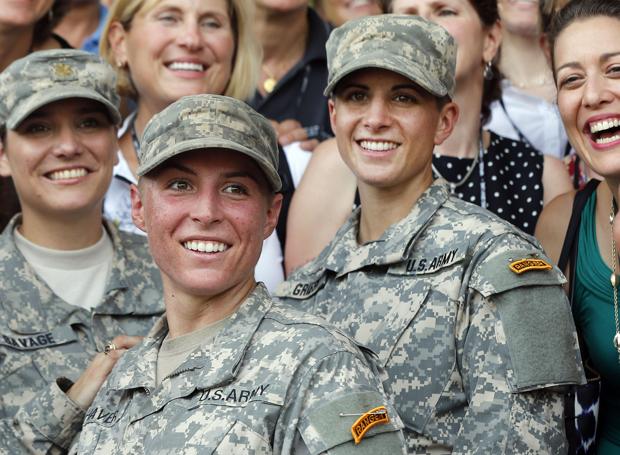
The historic graduation of the first two female soldiers to complete the Army's rigorous, nine-week Ranger School (the Army opened Ranger School to women for the first time this year) - 1st Lt. Shaye Haver of Copperas Cove, Texas, and Capt. Kristen Griest of Orange, Conn. - on Aug. 21 in a ceremony at Fort Benning, Ga., focuses renewed attention on the issue of whether women in America's armed forces should serve in direct combat roles.
We believe women who wish to put their life on the line in defense of our country deserve nothing less than the same opportunities afforded men.
On Jan. 24, 2013, Defense Secretary Leon Panetta lifted a ban on female soldiers serving in combat positions, thus setting in motion a three-year review and transition for each branch of America's armed services.
"Everyone is entitled to a chance," Panetta said at the time.
Under the ban, women were excluded from some 300,000 jobs. Today, some 240,000 positions, largely in infantry and armor units, remain closed to women. According to a June Military Times story, leaders of the Army, Navy, Air Force and Marines this year must eliminate gender restrictions for all jobs or request, by Jan. 1, formal waivers from Defense Secretary Ash Carter.
"We've really tried to give them the time that they need to finish their studies," Juliet Beyler, the Pentagon's director of officer and enlisted personnel management who is overseeing the transition, said for the Military Times story.
Advertisement
In our minds, the first graduations of female soldiers from Army Ranger school and the opening of all combat jobs to women are natural next steps in the evolution of women's roles in our nation's military.
Today, more than 200,000 women serve in America's armed forces, more than 35,000 of them as officers. Women have, in fact, distinguished themselves in combat-support positions, such as helicopter pilots and medics. Some 300,000 women served tours of duty in Iraq and Afghanistan; more than 150 of them were killed and hundreds more were injured.
We do not wish to see the nation's defense diminished, so we do not support lowering of standards for combat positions, but if a woman can prove herself equal to men in completing the necessary training, then we believe she is entitled to the honor of wearing America's uniform into battle.
In nearly all professions and walks of life, we as a nation have moved beyond outdated, gender-based concerns and stereotypes to proper acceptance of equal opportunities for women. Because we have absolute confidence America's military is up to whatever task or challenge it might face, we believe it more than capable of breaking down remaining barriers to women in combat and making the new rules work.

[VIDEO] Univision’s Jorge Ramos: Kate’s Law Is Unfair To Illegal Aliens

Guess what? Law is not decided on whether it is fair to illegal aliens, people who are already breaking the law, law is based on what is in the best interests of the citizens of the United States.

[EDITORIAL] High schools should offer early U.S. history classes

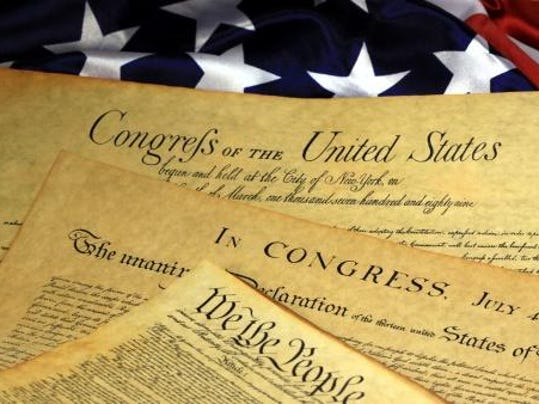
It's hard to believe that high school students in South Dakota do not study the framing of the Constitution, the events preceding the Revolutionary War or anything of substance about the early days of the Civil War.
ConstitutionBut that's true, and it could continue that way since the state Board of Education declined to require the study of early American history in its newly adopted history standards. In this rewriting of 2006 standards, schools only are required to cover recent American history – events from the Civil War and beyond. Teachers are allowed to add lessons in early-American history, but they don't have to.
We urge the board to step back and take another look at this.
Currently, early American history is being taught in middle school classes. But we agree with a coalition of college professors who say an eighth grade history lesson doesn't prepare a student for college-level course work.
The group of 18 college and university history professors from South Dakota schools lobbied the board to broaden the history requirement during nearly a year-long series of hearings on the proposed new standards.
They wrote a letter to the board of education detailing their concerns, beginning with the fact that students are not prepared for college level work in U.S. history courses and are challenged when asked to think historically.
Ben Jones, dean and associate professor of history at Dakota State University, has said he and his colleagues are "astounded by the level of ignorance" of U.S. history that they see in freshmen.
But there are other important reasons to teach high school students about our nation's early history.
Constitutional topics are common in today's political debate and students without a solid understanding and who do not have the appropriate level of context for these discussions are at a disadvantage. As citizens, we need to understand our rights and duties as well as appreciate how they came to be.
The Constitution is referenced in nearly every important election campaign. The separation of church and state, religious and press freedoms, the 2nd Amendment and gun rights are all popular political topics of our time. But without an understanding and appreciation of the early debates on these matters, young citizens are not able to accurately assess Constitutional protections and threats. Rhetoric and misinformation can easily fill the void.
Board of Education President Don Kirkegaard said last month that the decision not to require the early history instruction was a compromise that allows local school administrators and teachers to make the decision on what to include in history instruction.
But no compromise was needed here. History should be taught comprehensively, not fragmented by eras.
Recently, there was a national push to give every high school student the U.S. citizenship test to pass in order to graduate. The effort was championed by former U.S. Supreme Court Justice Sandra Day O'Connor and former New York mayor Rudy Giuliani.
South Dakota lawmakers embraced the notion but fell short of requiring the exam. They said students needed to learn the material before graduation but didn't have to take the test.
We should require more of our young people.
We think the college professors summarized it well, in urging the board to add early American history instruction to the first half of the 11th grade year, in addition to the 8th grade history lesson. They said the state should re-engage "the more mature student with increasingly complex material that builds upon their existing knowledge. By doing so, we hope that students will have greater success understanding their history and ultimately employing it as a citizen."

[VIDEO] CHRISTIE SAYS WE SHOULD TRACK FOREIGNERS LIKE FED EX TRACKS PACKAGES!!

Chris Christie got a little bit of criticism for saying that we should bring in Fed Ex to track foreigners who come into America on a VISA just like the company tracks packages in order to prevent their staying to become illegal aliens.

[COMMENTARY] Rebuilding infrastructure will help California thrive

Rebuilding infrastructure will help California thrive: Guest commentary
California is the epicenter of innovative technologies. We take pride in being the home of Silicon Valley and the birthplace of groundbreaking products.
But most of us forget that we need strong infrastructure systems to ensure we can continue such success and keep pushing the envelope.
I know — in our digital era of smartphones being able to broadcast our every selfie, the methodical process of climbing out of our infrastructure deficit is not the sexiest of topics.
But here’s the thing: The majority of California’s transportation and other infrastructure systems were built between the 1950s and the early 1970s — when California only had a population of 27 million and a much smaller, less diverse economy.
Today, California is home to more than 38 million people and projections show the population will grow to 50 million by 2040 — all of whom travel our roads, rails and airways for work, vacation and other activities. Californians currently register nearly 32 million vehicles per year and drive 324 billion miles annually.
These millions of Californians and much of the nation also rely on California’s infrastructure systems to quickly get local products such as fruits and vegetables to their supermarkets as well as import and export products through our state’s ports.
This is not to say that our state cannot accommodate growth — we can. But we need to ensure that our transportation, water delivery and freight systems are updated and strong enough to not only accommodate California’s residents, but also help them thrive.
Fortunately, Gov. Jerry Brown knows the critical status of our infrastructure and set aggressive goals to improve the existing deficit, such as pushing forward the nation’s first high-speed rail system, the Bay Delta Conservation Plan, and encouraging the Legislature to tackle the deferred maintenance of our roads and bridges by convening a special session.
The Legislature has started to make progress in the special session on a deal to tackle the billions in deferred roadway maintenance costs — which are currently estimated at $59 billion. With California being an international trade gateway, we must be able to move billions of dollars worth of goods and services across a massive state and through our international ports without our roadways and bridges falling apart.
Right now, the state’s current fuel excise tax — on which much of transportation funding depends — is sufficient to fund only $2.3 billion of work annually, leaving $5.7 billion in unfunded roadway repairs each year. California needs to find more reliable funding streams to repair and build out transportation corridors. By broadening the revenue streams and moving toward a model where all road users equitably pay their fair share, we will ensure our roadways are repaired, upgraded and expanded in a timely manner.

STUDY: CHICAGO CRIMINALS AVOID GUN SHOWS, INTERNET SALES, BUY GUNS ON STREET

REUTERS/RALPH D. FRESO

A new study conducted by the University of Chicago Crime Lab, inmates in the Cook County jail said they get they guns on the streets from “personal connections” rather that outlets like guns shows and the internet.

The study focused on “inmates who were facing gun charges or whose criminal background involved gun crimes.”
According to the Chicago-Tribune, Crime lab co-director Harold Pollack said the study shows that “some of the pathways [regarding guns] people are concerned about don’t seem so dominant.” He said very few inmates indicated using gun shows or the internet. Rather, they get the guns in undetectable ways on the street. He said the inmates know they run the risk of being caught by police but “were less concerned about getting caught by the cops than being put in the position of not having a gun to defend themselves and then getting shot.”
The vast majority of the inmates used handguns to commit their crimes or protect themselves, very few cited using “military-style assault weapons.” And they said their habit was to get rid of a gun after one year because of the “legal liability” of being caught with a gun that could be linked to crimes they or others committed.”
As for specifics regarding sources for purchasing guns, some of the inmates indicated that gangs have individuals with a Firearm Owners Identification Card who buy guns then sell them to gang members. Others indicated using “corrupt cops” who seize guns then “put them back on the street.”
The inmates made clear they do not walk into gun stores to buy guns. Which proves a point Breitbart News, Gun Owners of America, and other gun rights groups have made for years; namely, that background checks place a burden on law-abiding citizens which criminals easily avoid.

The markets were a roller coaster this past week

The markets were a roller coaster this week
Market selloff. Market rout. Recovery. Capitulation.
Investors heard all these words this week as U.S. markets took a roller coaster ride from the depths on Monday to a historic reversal just two days later. (Tweet this)
Here are some of the milestones hit throughout this historic week:
  • All major averages closed up for the week, reversing steep declines.
  • At this week's lows: the Dow was down 6.62 percent, the S&P 500was down 5.27 percent and the Nasdaq was down 8.79 percent (all lows came on Monday morning).
  • This is just the third time in the Dow's long history that the index has completely wiped out weekly losses of at least 6.6 percent and the first time since the last week of October 1987 (the only other time was in October 1931).
  • The Dow traversed more than 10,000 points this week, suffering seven straight days of triple digit moves, including its third biggest point gain ever on Wednesday of 619.07 and eighth biggest loss ever of 588.40 on Monday.
  • This week was also the biggest intraday reversal for the S&P 500 since September 2008 (the week of Lehman's bankruptcy).
  • Now for the Nasdaq: this week is the biggest intraweek reversal in the index's history (it has never recovered from a weekly loss of at least 8.79 percent to finish the same week with a gain).
The outlook was bleak on Monday as the Dow Jones industrial averagesunk more than 1,000 points at the open. But by Wednesday, the Dow had closed up more than 600 points for one of the biggest reversals in U.S. market history (by points).
On Tuesday, the Dow collapsed in the last hour of trading to end more than 200 points in the red.
But the next day, the Dow rallied, ending more than 600 points higher.
The Dow over the five-day trading period.
—CNBC's Robert Hum, Christopher Hayes and Gina Francollacontributed to this report.

Sunday, August 30, 2015

The Clintons Continue To Clinton

The Clintons Continue To Clinton - Derek Hunter - Page 1
What a mess. Every week, seemingly every other day, there is a new shady revelation about Bill and Hillary Clinton that manages to top the last one. For them there seems to be no bottom; for their supporters, there seems to be no self-respect.
The hundreds of millions of dollars from corrupt governments, billionaires with agendas and God knows who else. The server wiped so thoroughly – and no, not with a cloth – you can tell someone learned the importance of cleanliness from the blue dress. And now we learn Bill, the former president, with more money than he possibly could spend in his lifetime, sought approval to take even more from some of the worst human garbage ever to walk upright. (More on this later.)
It’s enough to make the sane wonder what the hell is wrong with these people.
But Clinton lovers are not sane. They are not rational. Hillary could give a press conference and explicitly call her supporters the dumbest people on the planet while Bill stood behind her throwing puppies and kittens into a wood-chipper, and she’d still have a base of support.
A new Quinnipiac Poll found the top three words Americans associated with her were: 1. Liar; 2. Dishonest; 3. Untrustworthy. The first positive word people associated with her was “experience,” which was given by less than half the number of respondents who answered “liar.”
That is awful, yet she is the best the Democratic Party has to offer.
As “the best,” Hillary Clinton is now so weak that Joe Biden – JOE FREAKING BIDEN – is now seriously considered a possible savior for the party’s chances.
It’s because the Clintons are known by those three words – dishonest, untrustworthy liars.
How else to explain Bill Clinton, a former president and even then a potential future first husband, asking for (and not getting) State Department permission to deliver a paid speech in the Democratic Republic of the Congo?
Women are terrorized in the Congo, routinely raped and worse. Why on Earth would anyone, let alone a former president, wish to speak there and, as part of the package, have a photo-op with the country’s leaders?
Via: Townhall
Continue Reading.....

The Data Destroyers


Government fears accountability above all. 

A few weeks ago, the California education department did a peculiar thing: It scrubbed historical data about standardized-test scores from its public DataQuest website. This being a government agency, it immediately began to lie to the public about why it had done this.

California law forbids using comparisons between different tests to set policy or evaluate programs. This makes sense: If last year 40 percent of students received 85th-percentile ratings on a standardized test and then this year 70 percent of students received 85th-percentile ratings on a different standardized test, it is likely that the radical difference is in the test, not in students’ performance. 

The law, however, says not one word about making historical test-score data available to the public or suppressing that data. Naturally, California then cooked up a new lie: The data hadn’t been deleted at all, the education department said, simply moved to another part of the website. That might be technically true, inasmuch as the data was no longer available on the section of the website where — get this — historical data about test scores is published; the department says it was still made available to researchers. 

That’s one definition of public service: making it more difficult for citizens to access information about their government, obstructing informed democracy, and being a general pain in the Trump. RELATED: The Obama Administration’s Newly Political Approach to FOIAs All that was really required was an asterisk. California is changing its standardized-testing practices to bring itself into alignment with Common Core standards. 

The results from the new tests will not be comparable to the old ones on a point-by-point basis. What actually seems to have happened here is that the California department of education was worried that the old data and the new data would be used to make invalid comparisons. Which is to say, the people who run California’s schools have put forward the self-indicting thesis that Californians are too stupid to understand the issue. They should know.


Hate and Anger are not mental Illnesses

This week we have suffered additional senseless and tragic shootings of innocent people here in America.

insert pictureThis past Wednesday, Vester Flanagan II (aka:  Bryce Williams) executed two former co-workers from WDBJ-TV in Roanoke, VA.  Flanagan had a history of anger issues mostly stemming from his being both a black man and gay.  It appears his anger continued to grow over several years and between multiple jobs.  He had reached a point where common sayings or items and street names were viewed as racial attacks and taunts against him.  His hate grew right along with his anger and this week it reached a boiling point.

It has been reported that he considered the following as racial attacks:  seeing a watermelon on top of an ice chest at work, someone stating that it was time to “go into the field” before going out on location for their job, and someone saying the name of a street “Cotton Lane”.  He had filed a discrimination suit against another former employer claiming he was harmed due to being gay.  When that was dismissed and it was shown that there are other gays at the same employer, he changed the suit to racial discrimination.

Flannigan approached, after what appears to have been a planned attack, reporter Alison Parker and her cameraman Adam Ward while they were conducting a live interview of another person (all white) out in public for the morning show on the station.  He had taken issue with each of these two while he worked at the station, prior to being fired over his anger.  Video footage has been made public from not only the cameraman but also the shooter, who filmed the attack.  The shooter walked up and stood slightly behind and to the left of the cameraman.  The three people standing in front of him were all absorbed in the interview and did not notice him.  He pulled out his semi-automatic pistol and aimed it at Alison.  Then, it appears that he noticed that Adam had directed his camera away from the two ladies and was shooting a scene to the side.  Flanagan lowered his gun and waited for the cameraman to get the ladies back on camera before raising the gun again and beginning to shoot.


[VIDEO] Scott Walker Calls Border Fence with Canada a ‘Legitimate Issue’

Speaking to the governor from a state that shares a northern border with Canada, Chuck Todd wanted to know this morning on Meet the Press what Scott Walker thinks about the possibility of building a fence to keep people from coming into the country that way. “Why are we always talking about the southern border and building a fence there?” he asked. “We don’t talk about a northern border.”
“If this is about securing the border from potentially terrorists coming over, do you want to build a wall north of the border, too?” Todd asked Walker.
“Some people have asked us about that in New Hampshire,” Walker replied. “They raised some very legitimate concerns, including some law enforcement folks that brought that up to me at one of our town hall meetings about a week and a half ago. So that is a legitimate issue for us to look at.”
To combat terrorism on U.S. soil, Walker said, “It starts with securing the homeland. It wasn’t just about building a wall and securing our borders. It was also about making sure our intelligence community has the ability for counterterrorism and the ability to go after the infrastructure they need to protect us.”
So while a Donald Trump administration will come complete with the “biggest, best wall ever” along the U.S.-Mexico border, a Walker presidency could well see a fence in the north.

Popular Posts