Tuesday, September 3, 2013

IRAN AGGRESSIVELY RECRUITING ‘INVISIBLE ARMY’ OF LATIN AMERICAN CONVERTS TO INFILTRATE U.S. THROUGH ‘SOFT BELLY’ OF THE SOUTHERN BORDER

Iran is recruiting an “invisible army” of revolutionary sympathizers in Latin America to infiltrate the U.S. through the “soft belly” of the southern border, U.S. officials and national security experts told TheBlaze. And they’re using one website in particular to do it.
Iran Aggressively Recruiting Invisible Army of Latin American Converts to Infiltrate U.S. Through Soft Belly of the Southern Border
Iranian President Hassan Rowhani, middle, attends a session of the Assembly of Experts in Tehran on Sept. 3, 2013. Iran’s Assembly of Experts is a body that selects the supreme leader and supervises his activities. (Getty Images)
The Iranian regime’s conversion efforts are becoming increasingly aggressive, especially over the Internet, with the goal of conducting operations against United States interests in the Western Hemisphere, according to U.S. government officials who spoke on the condition of anonymity due to the nature of their work in the region.
Islamoriente.com, which focuses on religion and politics, is one of Iran’s main recruitment and conversion websites for Latin America on the Internet, TheBlaze has learned. The site, which launched in 2008, includes links to Iranian television for Spanish speakers, anti-American news stories, essays on reasons to convert to Islam, chat rooms and a personal message from the Ayatollah Ali Hosseini Khamenei, the supreme leader of Iran.
Even as President Barack Obama waits for Congress to make a decision on Syria, the Iranian website wastes no time and has no shortage of stories ridiculing the U.S. administration for threatening to strike President Bashar Assad’s regime, a staunch ally of Iran.
Jim Phillips, a senior research fellow at the Heritage Foundation and expert in Iranian affairs, said Iran’s focus on Hispanic converts is a new evolution in Iranian operations in Latin America. Phillips said Khamanei’s message titled “The Importance of Work and the Nobility of the Worker” in Islam, is significant because the Ayatollah is “normally a background player in these sorts of efforts and doesn’t usually play such a public role.”
Barack Obama’s Staggering Incompetence

It’s reported that President Obama was ready to order a military strike against Syria, with or without Congress’s blessing, but “on Friday night, he suddenly changed his mind.” According to the Huffington Post:
Senior administration officials describing Obama’s about-face Saturday offered a portrait of a president who began to wrestle with his own decision – at first internally, then confiding his views to his chief of staff, and finally summoning his aides for an evening session in the Oval Office to say he’d had a change of heart.
In light of all this, it’s worth posing a few questions:
1. Why didn’t the president seek congressional authority before the administration began to beat the war drums this past week? Did the idea not occur to him? It’s not as if this is an obscure issue. When you’re in the White House and preparing to launch military force against a sovereign nation, whether or not to seek the approval of Congress is usually somewhere near the top of the to-do list.
And why has the urgency to act that we saw from the administration during the last week–when Assad’s use of chemical weapons was referred to by the secretary of state as a “moral obscenity”–given way to an air of casualness, with Obama not even calling Congress back into session to debate his military strike against Syria?
2. The president didn’t seek congressional approval for his military strike in Libya. Why does he believe he needs it in Syria?

Top 7 CA Facts That The Media Always Ignore

Drum roll, please

The real Cali story is infinitely darker. It’s time for The Top 7 Things The National Media Always Ignore About Jerry Brown.
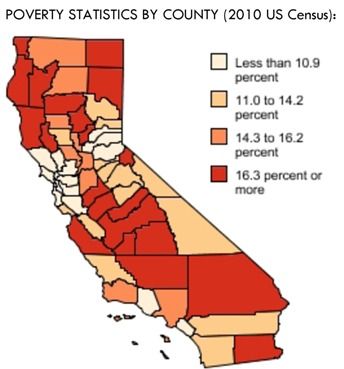
page-01. California has the worst poverty rate of any state. Worse than Mississippi. Worse than West Virginia. Worse than Nevada. So much for the narrative of Jerry Brown as Mr. Economic Growth.
2. California’s unemployment rate may be down from its past high, but that’s not because of any broad economic rebound at all, it’s because part-time jobs are growing and hundreds of thousands of residents have stopped looking for jobs. In the Labor Department’s U-6 category, measuring the percentage of adults who want full-time jobs but can’t find them, California has the second worst rate in the U.S. About 19 percent of these workers — nearly one in five — can’t find work.
3. The idea that the state’s finances are in good shape depends on really aggressive cherry-picking. Here’s what I wrote in June:
California is far from being in good fiscal health. When Gov. Jerry Brown talks about reducing the ‘wall of debt’ he inherited upon taking office three years ago, he leaves out huge problems — problems that Sacramento has either not addressed or barely addressed:
“• $87 billion in unfunded liabilities for the California Public Employees’ Retirement System. The $87 billion would be far higher if not for the rosy investment assumptions used by CalPERS.
“• $73 billion in unfunded liabilities for the California State Teachers’ Retirement System, a sum that increases a staggering $6 billion a year. The $73 billion would be far higher if not for the rosy investment assumptions by CalSTRS.
“• $64 billion in unfunded liabilities for health insurance coverage guaranteed to retired employees.
“• $8.2 billion in money borrowed from the federal government to replenish the state’s broke unemployment compensation fund. California only pays the interest on the debt.”

What happens if the debt ceiling isn't raised?

The Treasury has been up against the debt ceiling since May 19. But Secretary Jack Lew warned last week that his ability to create headroom under the $16.7 trillion limit will run out in mid-October. The threat facing the Treasury, and the nation, is what happens then if Congress doesn’t raise the limit.
In the worst-case scenario, the government fails to make payments on the interest on its debt, an outcome that could create a global financial crisis.
Yet Congress is not close to lifting the limit. With just a few weeks to go, House Speaker John Boehner, R-Ohio, is demanding spending cuts in return for the House voting to raise the ceiling, while President Obama is saying he won’t negotiate over the government paying its debts.
What if Congress doesn’t raise the debt ceiling in time? The following is a stage-by-stage guide to the consequences that would unfold if the cap isn't raised. It is based on the last brush with the debt ceiling in 2011 as well as earlier episodes — the debt ceiling has been raised 78 times since 1960.

Extraordinary measures

The Treasury currently is paying all of the government’s bills without issuing new debt by engaging in what it calls “extraordinary measures.” By manipulating accounts and postponing scheduled intra-government transfers, the Treasury can eliminate the need to issue bonds to finance those needs, and instead use newly issued bonds to pay obligations as they come due, without adding to the level of debt.

Obama's regulations are viewed as seriously flawed

In fact, why limit it to Obama? The entire regulatory process is a mess, with no way to root out regs that have outlived their usefulness or become too burdensome. Plus, the process is opaque and vulnerable to industry lobbyists.
Over the years, Congress and presidents have tinkered with the inner-workings of the regulatory apparatus, placing new restrictions on agencies charged with writing rules, and ordering them to root out those that are outdated or overly burdensome.
Despite those tweaks, the current system lacks any institutional mechanism to expunge unneeded federal restrictions. 
There are no strict time limits requiring administrations to either issue or withdraw proposed rules aside from those specifically set by laws or the courts. And both advocates and critics of stronger regulations complain of a lack of transparency to the process.
"It's totally broken," said Peg Seminario, the AFL-CIO's longtime director of Occupational Safety and Health. "The system is basically a poster child for how government doesn't work."
Yet when it comes to potential solutions, there is little consensus.
Republicans and industry groups, who have bemoaned what they view as overly aggressive federal agencies, want more restrictions on the rulemaking process and a greater reliance on economic analysis in decisions regarding new regulations.
Democrats, unions and public interest groups, meanwhile, say agencies are already hamstrung by existing restrictions on their authority, and argue that open-ended White House reviews have led to a pattern of delays in important protections.
Via: American Thinker

Continue Reading....

Obama congratulates American Muslims on same day he moves for military action against Syria

Obama-arranged marriage of Marxism and Muslim is leading the world down a deadly path of increasing civilian death


On the same day that President Barack Obama said that the United States should take military action against Syrian President Bashar al-Assad for using chemical weapons on civilians and turned to Congress for approval, he released a video message from the White House congratulating American Muslims on the many achievements and contributions they have made to American society from its early history to the present day.

Was it just before the video release that he took the touted 45-minute walk during which he made up his mind to strike Syria?

The congratulating American Muslims video, aired Saturday at the Islamic Society of North America (ISNA) annual convention, highlighting “the myriad of ways the American Muslim community, and specifically ISNA leadership, has served as an effective partner in promoting inter-religious initiatives in the U.S. and religious freedom for minorities around the world.” (PRNewswire-USNewswire, Aug. 31, 2013).

That is, of course, unless you happen to be a Christian in Syria, Egypt, Nigeria, Sudan, Pakistan, Iraq, Bangladesh, Somalia, Tanzania, Libya, Cameroon, the Netherlands, Kenya, Turkey, Algeria, Norway, Lebanon, Indonesia, the Philippines, Kosovo, South Africa, and even in the U.S., where on March 24, 2013, in Ashtabula, Ohio, a Muslim convert walked into a church service with a Koran and gunned down his Christian father while praising Allah. (TheReligionofPeace)


Popular Posts